
The whole
record.
Ten compound records, seven topic primers and a dated weekly log of what changed. Every entry cites its sources and says what kind of evidence stands behind it. Nothing here is for sale.
- 10Compound records
- 07Topic primers
- 12Entries on record
- 01Weekly records
NO.
A recommendation without a decision
The week opens with the regulatory question unresolved. The July recommendation to allow compounding of six peptides sits with the agency, state pharmacy boards are moving in different directions, and a new public-health explainer has put the same compounds in front of a general audience. In trials, the retatrutide programme has now reported four Phase 3 results. Twelve entries follow, each with its sources.
Contents
- REGULATION
- 03
- TRIALS
- 02
- PAPERS
- 03
- EVIDENCE
- 01
- PUBLIC AND POLICY
- 02
- INDUSTRY
- 01
In this record
- 01Six peptides recommended for the 503A bulks list
On 23–24 July 2026 the FDA's Pharmacy Compounding Advisory Committee voted to recommend BPC-157, KPV, TB-500, MOTS-c, epitalon and Semax for the 503A bulks list. Emideltide was not recommended.
- 02From Category 2 to review: how twelve peptides came off the restricted list
In September 2023 the FDA placed nineteen peptides in Category 2. In April 2026 it removed twelve of them after their nominations were withdrawn and scheduled advisory meetings to consider adding them to the 503A bulks list.
- 03FDA proposes to end 503B compounding of semaglutide, tirzepatide and liraglutide
A 30 April 2026 proposal would exclude the three GLP-1 drugs from the 503B bulks list, closing the outsourcing-facility route that opened during the shortage years.
- 04Retatrutide: four Phase 3 readouts in 2026
Between March and July 2026 Eli Lilly reported topline results from TRANSCEND-T2D-1, TRIUMPH-1, TRIUMPH-2 and TRIUMPH-3. Weight reduction at 80 weeks on the 12 mg dose ranged from 20.8 % to 28.3 % depending on the population.
- 05Orforglipron approved; the oral GLP-1 question
April 2026 brought approval of orforglipron, the first oral small-molecule GLP-1 receptor agonist. Oral options so far produce less weight reduction than leading injectables but are easier to make and take.
- 06GLP-1 drugs recruit hunger neurons to sustain fat loss, Yale study finds
Researchers at Yale report that GLP-1 therapies recruit agouti-related peptide neurons, long treated as drivers of hunger, to help maintain fat loss.
Ten
compounds.
One reference record per compound, reviewed quarterly. Evidence labelled, regulatory position kept separate.
-
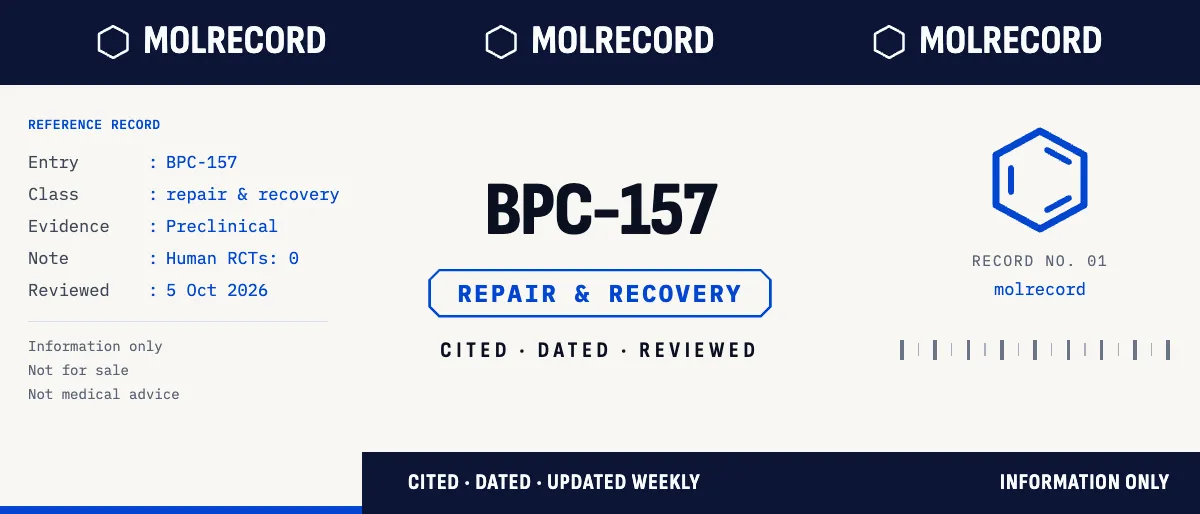
BPC-157
A synthetic fifteen-amino-acid peptide derived from a protein in human gastric juice, studied since the early 1990s almost entirely in rodents.
4 ENTRIESOPEN → -
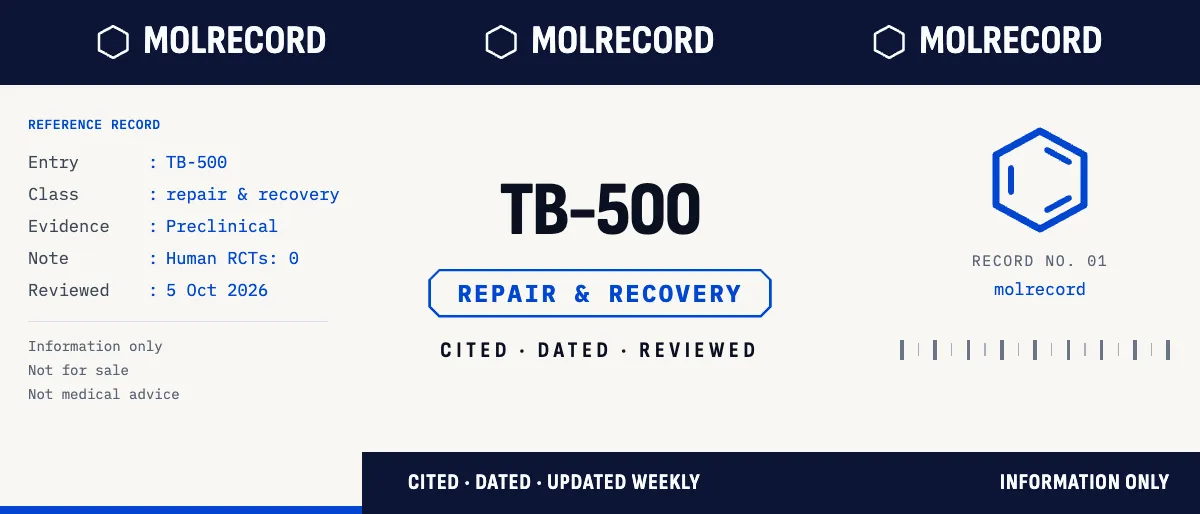
TB-500
A synthetic fragment of thymosin beta-4, a naturally occurring protein involved in cell migration and tissue repair.
3 ENTRIESOPEN → -
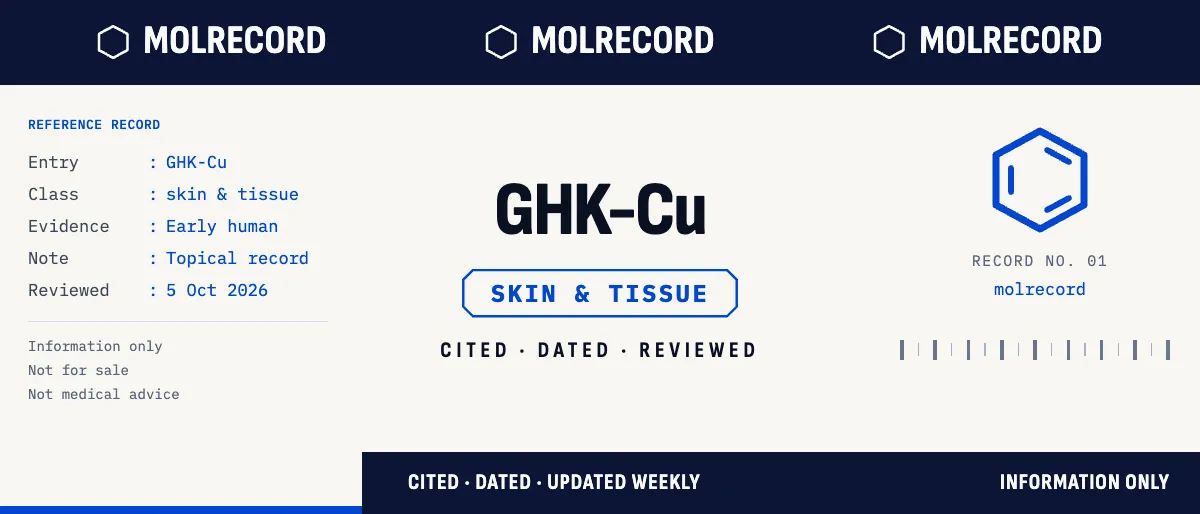
GHK-Cu
A copper-binding tripeptide (glycyl-L-histidyl-L-lysine) found in human plasma, used for decades in topical cosmetic formulations.
1 ENTRYOPEN → -
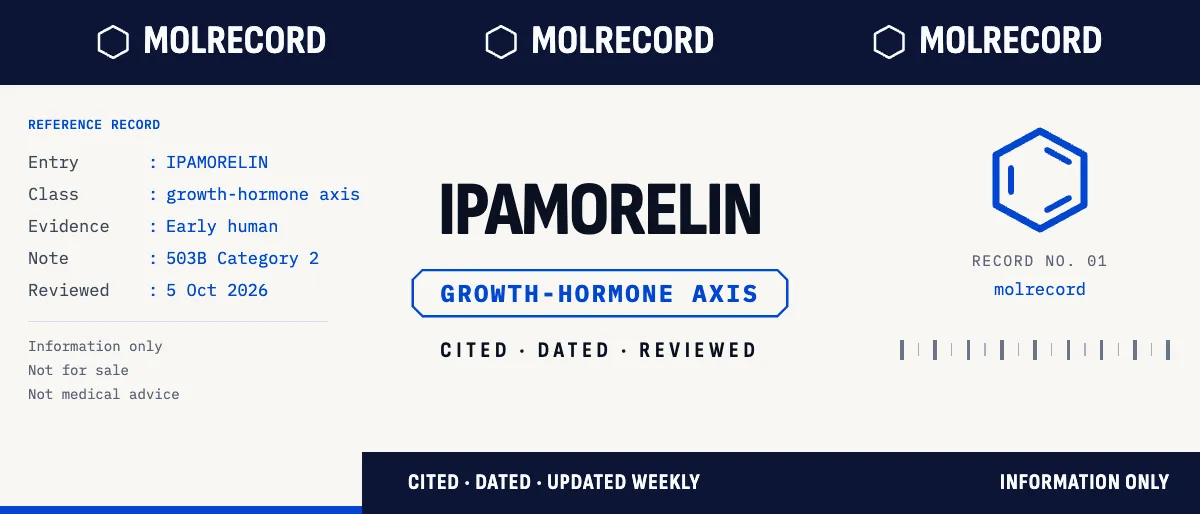
Ipamorelin
A pentapeptide growth-hormone secretagogue that acts on the ghrelin receptor, developed in the 1990s and studied for post-operative ileus before development stopped.
2 ENTRIESOPEN → -
CJC-1295 (no DAC)
A modified analogue of growth-hormone-releasing hormone (GHRH 1-29). The 'no DAC' form lacks the drug-affinity complex that extends the half-life of the DAC version.
2 ENTRIESOPEN → -
Tesamorelin
A stabilised GHRH analogue approved for reducing excess abdominal fat in adults with HIV-associated lipodystrophy.
0 ENTRIESOPEN → -
MOTS-c
A sixteen-amino-acid peptide encoded in the mitochondrial genome, described in 2015 as a regulator of metabolic homeostasis.
3 ENTRIESOPEN → -
Semaglutide
A long-acting GLP-1 receptor agonist approved for type 2 diabetes and weight management, with an oral peptide form for weight management approved in late 2025.
4 ENTRIESOPEN → -
Tirzepatide
A dual GIP and GLP-1 receptor agonist approved for type 2 diabetes and weight management.
2 ENTRIESOPEN → -
Retatrutide
An investigational once-weekly agonist of the GIP, GLP-1 and glucagon receptors, developed by Eli Lilly.
1 ENTRYOPEN →

Seven
primers.
- 01
Regulation and policy
Compounding law, advisory votes, state boards and the gray market.
5 ENTRIES → - 02
Metabolic and the GLP-1 class
Incretin agonists, multi-receptor agents and what happens outside the trials.
Semaglutide Tirzepatide Retatrutide5 ENTRIES → - 03
Repair and recovery
BPC-157, TB-500 and the gap between animal and human evidence.
BPC-157 TB-5001 ENTRY → - 04
Growth-hormone axis
GHRH analogues and secretagogues: ipamorelin, CJC-1295, tesamorelin.
Ipamorelin CJC-1295 (no DAC) Tesamorelin0 ENTRIES → - 05
Mitochondrial
Mitochondrial-derived peptides such as MOTS-c.
MOTS-c0 ENTRIES → - 06
Skin and tissue
Copper peptides and wound-healing materials.
GHK-Cu0 ENTRIES → - 07
Methods and manufacturing
How peptides are made, tested and supplied; who makes them.
1 ENTRY →
- No dosing
- No sourcing
- No vendors
- No affiliate links
- No superlatives
- Every sentence has a source
- Corrections logged in the open
-
Every sentence has a source
Full citations, each labelled by kind: paper, press release, registry record, regulatory document, news report.
-
Evidence is labelled
Preclinical, early human, controlled trials or approved indication, with the regulatory position kept separate.
-
Reviewed on a schedule
Compound records quarterly, topic primers when the position changes, corrections logged in the open. About and method